
The Blueprint for Freedom: What the Velvet Revolution Teaches Us About Bringing Down Systems of Control.
Introduction
The Velvet Revolution in Czechoslovakia is often described as a miracle, but complexity theory suggests it was the predictable outcome of accumulated small disruptions. Prigogine and Stengers (1984) show that dissipative systems, when pushed far from equilibrium, reorganize into new patterns rather than collapse. Plowman et al. (2007) extend this to organizations, explaining how change unfolds through fluctuation, amplification, stabilization, and recombination. Boulton, Allen, and Bowman (2015) make a similar case for leaders in turbulent environments, while Wheaton and Kavan (1992) document how cracks in 1989 paved the way for collapse. Together, these works suggest that revolutions, like organizations, follow recognizable patterns once old systems begin to fracture. For me, this is personal. My father’s escape from Czechoslovakia was one of those cracks, and the stories I grew up hearing remind me how small acts of courage can ripple forward into systemic change. To unpack this further, the next step is to examine what dissipative systems mean and how the idea has been applied to leadership and organizational change.
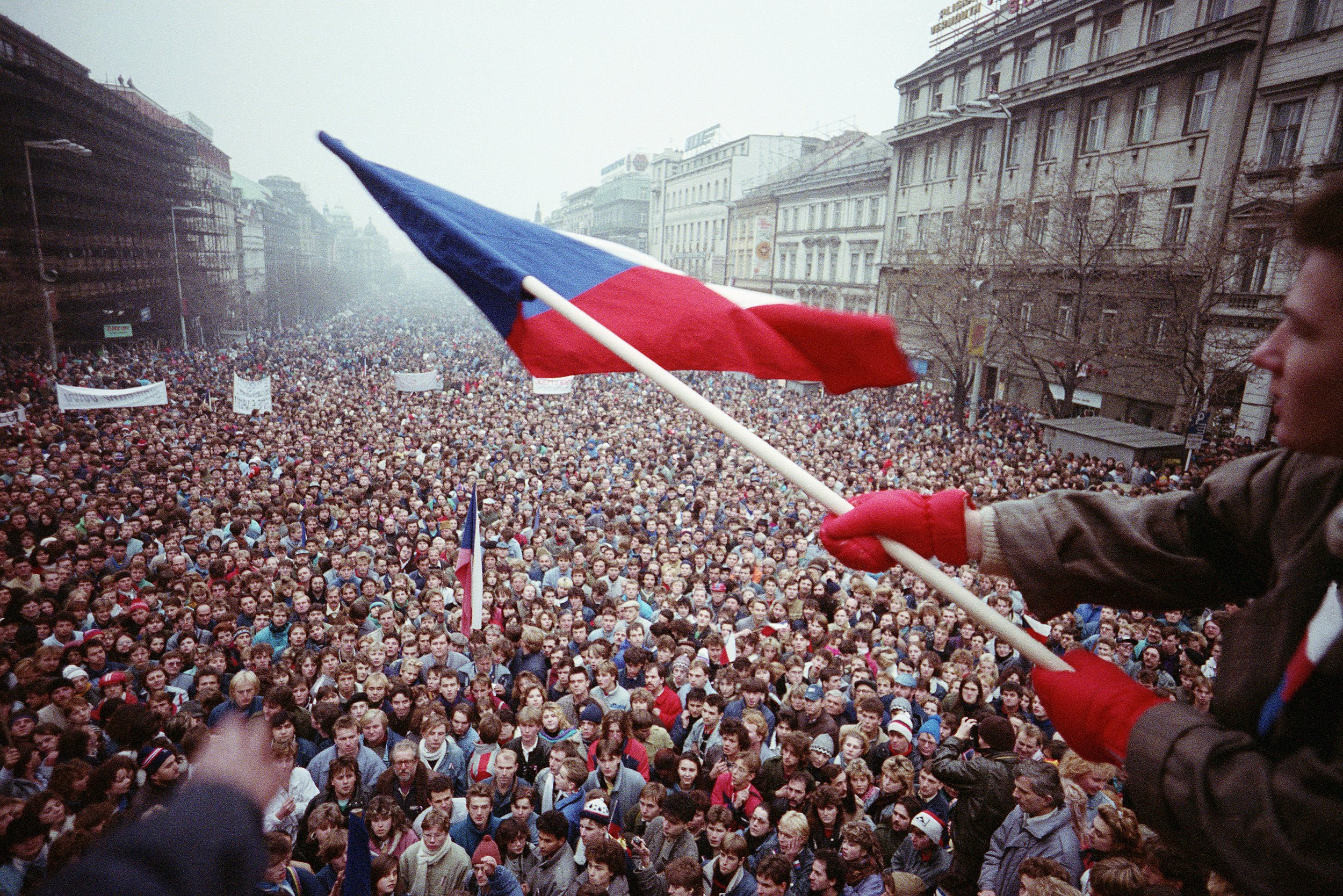
If science shows that systems reorganize once equilibrium is disturbed, Ralph Stacey (2012) helps us see how this actually plays out in human systems. He describes organizations as complex responsive processes of relating, where new patterns emerge through everyday conversations and micro-interactions. This stands in sharp contrast to managerial models that frame organizations as machines to be designed and controlled. Applied to the Velvet Revolution, this perspective helps explain why no single master plan was able to topple the regime. Instead, momentum came from countless conversations, refusals, and small acts of dissent, interactions that no central authority could predict or contain. That resonates with me, because when I think of the Revolution, I do not picture just the rallies in Wenceslas Square but also the quiet courage of people at kitchen tables, passing ideas forward. In Stacey’s terms, meaning and order were constantly renegotiated at the local level, and over time, these interactions scaled into systemic change. Seen in this light, revolutions align with the science of dissipative systems: transformation emerges not from control, but from disturbance, interaction, and the emergence of new patterns.
Dissipative Systems: From Science to Leadership
A dissipative system is an open system that, under stress, reorganizes into a new pattern instead of collapsing outright. Prigogine and Stengers (1984) explain that once a system reaches a bifurcation point, even small fluctuations can tip it into a new order. Boulton, Allen, and Bowman (2015) make this logic applicable to leaders, demonstrating how tipping points, attractors, and feedback loops influence transformation. Stacey (2012) notes that in human systems, nonlinearity and the limits of control make the process even more challenging to predict. Together, these scholars suggest that disruption is not always destructive, it can be generative. That is the backbone of how I read the Velvet Revolution. The regime did not collapse from one decisive act. It was pushed past equilibrium by many small cracks that created space for reorganization. To make the leap from chemistry to politics, the next step is to see how organizational scholars apply this thinking to leadership and change. Bushe (2015) argues that change emerges dialogically, through new conversations that trigger self-organizing dynamics, rather than from prescriptive plans. Shaw (2002) makes a similar point in describing organizing as changing conversations, which helps explain why Velvet Revolution leaders leaned on values like truth and dignity to sustain dialogue that stabilized a democratic order.
These same dissipative dynamics are visible in organizations, where ordinary interactions can unexpectedly scale into transformation. Plowman et al. (2007) show how small shifts in a church community cascaded into radical change that mirrored the four stages described in science. Shaw (2002) reframes this through the lens of dialogue, where the way people talk reshapes patterns of organizing. Bushe (2015) reinforces the idea that new conversations create the conditions for self-organization, turning local meaning-making into system-wide change. Chiles, Meyer, and Hench (2004) apply dissipative logic to the Branson theater industry, illustrating how entire industries can grow from local fluctuations. Uhl-Bien and Arena (2018) note that enabling leadership creates the adaptive space for these dynamics to emerge. What strikes me is how often these patterns surface in ordinary places—churches, conversations, even small markets—long before they reshape entire systems. The common thread is that leaders do not directly cause transformation. They prepare the conditions so sparks can catch, values can stabilize into new habits, and recombination becomes possible. With this perspective in mind, I now turn to the Velvet Revolution itself, beginning with the first stage, small fluctuations that cracked open a rigid system.
Stage 1: Fluctuation — Cracks in the System
Long before the crowds filled Prague in 1989, resistance to the communist regime showed up in small, everyday disruptions. Glenn (2001) documents how civil society groups organized underground lectures, circulated banned books, and kept theater alive without official approval. Wheaton and Kavan (1992) describe how student petitions and minor protests in the 1980s quietly chipped away at the regime’s veneer of stability. In the language of complexity, Plowman et al. (2007) refer to these early fluctuations as small disruptions that disturb equilibrium and prepare the system for transformation. These scattered acts were like the first tremors in a dissipative system. None looked decisive in isolation, but together they injected new energy into a rigid order already stretched thin. For me, this history is personal. My father’s escape was one of those micro-fluctuations, risky, uncertain, but proof that the system could not contain everyone forever. His story echoes thousands of others that slowly pushed the regime off balance.
Not all fluctuations were quiet or hidden. Some shocked the system outright, and none more than Jan Palach’s self-immolation in Prague’s Wenceslas Square in 1969. Krapfl (2013) recounts how Palach’s death jolted both citizens and international observers, becoming a symbolic attractor that gave dissent a lasting focus. Císař (2019) situates his protest in the broader tradition of contentious politics, where extreme individual acts unsettle dominant narratives. Stacey (2012) reminds us that in complex responsive processes, destabilization occurs when small acts resonate widely and shift collective meaning. Palach’s sacrifice was not a tactical plan for regime change but a fluctuation that echoed for decades. His name became a moral attractor, carried through memory and whispered in private networks the state could not silence. In the language of complexity, Palach became an attractor, his sacrifice pulled scattered dissent into a shared focus (Prigogine & Stengers, 1984). Organizational theorists extend this metaphor to human systems, where shared symbols and values stabilize new norms (Stacey, 2012; Boulton et al., 2015). Palach’s death worked in just this way, channeling scattered courage into a symbolic focus that disrupted the regime’s project of normalization, its effort after 1968 to restore silence, erase reform, and make repression feel routine. What began as a fluctuation could not remain static. For such sparks to reshape a system, they had to be amplified through networks, the next stage in the dissipative cycle.
Stage 2: Positive Feedback — Amplification of Small Acts
Fluctuations only matter when they spread, and in Czechoslovakia, the Charter 77 network was the key mechanism of amplification. Charter 77 began in 1977, when a small group of intellectuals and artists signed a petition demanding that the regime honor the human rights commitments it had already pledged to in international treaties. Skilling (1981) provides a definitive account, showing how this initiative formalized dissent by documenting abuses. Glenn (2001) explains how it transformed private frustrations into a shared, public platform. In organizational terms, Plowman et al. (2007) note that small disruptions gain significance when networks amplify them into recognizable patterns. Charter 77 was never about numbers but about visibility. Its petitions created feedback loops by making dissent public, proving that opposition was not isolated but widely shared.
Culture carried this same energy. Underground publishing, music, and theater became informal channels where resistance spread and found its voice. Garton Ash (1990) describes how clandestine plays and banned books built solidarity, while Wheaton and Kavan (1992) trace the surge of student protests in 1988–89 as cultural momentum spilled into the streets. Each act of dissent making the next one easier. Chiles, Meyer, and Hench (2004) show a similar pattern in Branson’s theater industry, where small creative acts multiplied into an entire cultural system. What strikes me is that much of the Velvet Revolution’s momentum came less from formal manifestos and more from songs, plays, and everyday courage that spread beneath the surface.
What gave this amplification unity was Václav Havel’s ethic of living in truth. In The Power of the Powerless (1978/1985), Havel argued that simply refusing to parrot propaganda was itself an act of resistance. Keane (1999) demonstrates how this ethic influenced the tone of dissent, maintaining unity among diverse groups through shared values and principles. Boulton, Allen, and Bowman (2015) describe how attractors work in complex systems, channeling otherwise scattered energy into recognizable patterns. Havel’s call to live in truth became such an attractor. It stabilized feedback loops so that courage became contagious and repeatable. Everyday acts of authenticity turned into a recognizable movement anchored in truth and dignity.
The same pattern shows up in organizations. Uhl-Bien and Arena (2018) argue that leaders enable small innovations to spread by protecting adaptive space rather than shutting it down. Plowman et al. (2007) demonstrate that even small shifts in organizations can escalate into large-scale reconfigurations once networks begin to amplify them. Stacey (2012) reminds us that amplification is fragile: it depends on people’s choices in the moment, their willingness to act, and the meaning they create together. Together, these studies reinforce the notion that amplification is delicate yet powerful. When networks, values, and leadership align, small acts cascade into transformation. In Czechoslovakia, truth and dignity provided a moral anchor, amplifying the movement's foundation and preparing it for stabilization into durable norms. As Bushe (2015) puts it, living in truth was a generative image, an invitation that oriented everyday conversations and facilitated the self-organization of collective action.
Stage 3: Stabilization — The Emergence of a Shadow Culture
By the late 1980s, the Czech resistance had stabilized around a shared set of values, truth, dignity, and responsibility, which gave the movement a sense of unity. Havel’s 1990 presidential address declared that truth and love must prevail, linking moral commitments to national renewal (Havel, 1990). Keane (1999) demonstrates that this language was not a sudden invention, but rather consistent with Havel’s earlier essays, in which he framed resistance as a moral duty rather than a political calculation. Complexity scholars describe this stage as stabilization. Boulton, Allen, and Bowman (2015) argue that after disruption, new regularities emerge that anchor the system. Stacey (2012) adds that norms and routines can self-organize even without central direction. In his view of complex responsive processes, stabilizing norms are reproduced through everyday interactions, which involve what people actually do and say together, rather than in formal design. In practice, these values gave dissidents simple, repeatable principles they could enact daily: refusing to lie, treating others with dignity, and taking responsibility for their actions. What began as scattered acts converged into recognizable norms, stabilizing the movement. For me, this was the moment when courage stopped feeling isolated and began to feel ordinary.
That stability produced what became known as a shadow culture, parallel institutions that mirrored the official ones but operated by very different rules. Glenn (2001) describes how underground journals, concerts, and discussion groups created alternative public spheres. Garton Ash (1990) notes that these spaces provided people with a taste of freedom and solidarity, even under heavy surveillance. Shaw (2002) notes that change often begins with new conversations, and these parallel structures provided spaces where different conversations could flourish. In complexity terms, this shadow culture functioned like a new attractor, a stable center of gravity that pulled people away from the regime’s narrative and toward an alternative vision of society. With this cultural foundation in place, the movement could endure until a political opening arrived.
Stabilization through values and parallel structures is not unique to revolutions. Organizations also settle into emergent norms after disruption. Stacey (2012) emphasizes that stability depends less on top-down control and more on the informal regularities people reproduce daily. Boulton et al. (2015) make a similar point, arguing that values act as anchors that keep systems cohesive under stress. Uhl-Bien and Arena (2018) note that leaders in adaptive systems must strengthen these stabilizing norms while still allowing for emergence. The Czech dissidents lived through a similar dynamic: truth and dignity anchored fragile practices, allowing them to endure until the opportunity arrived. In organizations today, values such as transparency, respect, and accountability can serve a similar stabilizing role, ensuring that emergent change does not collapse back into the old order. With stabilization in place, the Velvet Revolution was ready for the final stage of the dissipative cycle: recombination, when old resources are repurposed to build something new.
Stage 4: Recombination — Building the New from the Old
After the collapse of communism, the Czechs did not discard every institution but instead repurposed existing structures for democratic use. Wheaton and Kavan (1992) describe how former committees and local councils were quickly reoriented to facilitate free elections. Glenn (2001) shows how civic groups that had previously operated underground stepped into public roles, lending legitimacy to fragile new institutions. In organizational terms, Plowman et al. (2007) refer to this process as recombination, the reuse of old resources in new ways to stabilize emerging systems. Rather than starting from scratch, the Velvet Revolution showed resilience through adaptation. The old became the foundation of the new, which complexity theory predicts when systems reorganize after disruption. What strikes me here is how little was truly new. Change worked because people could recognize parts of the old world in the new order.
Recombination also unfolded symbolically, as public spaces themselves underwent a shift in meaning. Garton Ash (1990) recalls how Wenceslas Square, the site of Palach’s 1969 protest, became the heart of peaceful mass demonstrations in 1989. Skilling (1981) documents how citizens rapidly reappropriated squares and theaters once reserved for official propaganda. Boulton, Allen, and Bowman (2015) note that recombination often involves giving existing structures new meaning rather than inventing entirely new ones. The transformation of public space mirrored the transformation of cultural identity: what once reinforced control now embodied liberation.
On a personal level, Václav Havel’s rise embodied recombination. Keane (1999) traces how Havel’s authority came not from traditional politics but from the moral credibility he built as a dissident. Glenn (2001) highlights how his writings carried the values of resistance into the new order. Uhl-Bien and Arena (2018) argue that adaptive leadership often depends on recombining old authority with new contexts. Havel did exactly this. Carrying forward the ethos of resistance while guiding a fragile democracy. His presidency demonstrated how values that stabilize dissent can also stabilize democratic institutions.
Organizations display a similar capacity for recombination when they transform old resources into new strategies. Plowman et al. (2007) describe this as the final step in radical change, where remnants of past routines are redeployed in novel configurations. Laloux (2016), in Reinventing Organizations, offers a practitioner’s perspective, showing how even traditional hierarchies can be repurposed into more adaptive and self-managing forms. Shepherd, Williams, and Zhao (2022) reinforce this dynamic from a resilience standpoint, arguing that organizations often survive disruption not by abandoning familiar practices but by reusing and reframing them to embed new meaning and flexibility. Stacey (2012) notes that stability following disruption often emerges from adapting existing routines rather than imposing rigid new designs. Like the Velvet Revolution, organizations rarely start from zero. They recombine routines, spaces, and authority structures to stabilize transformation. Recombination is not the end of change but a foundation for ongoing adaptability, setting the stage for leadership in today’s turbulent environments.
Implications for Executive Leadership Today
The Velvet Revolution demonstrates that leaders cannot script emergence, but they can create conditions for it to grow. Uhl-Bien and Arena (2018) argue that leadership for adaptability is less about directing outcomes and more about opening adaptive space, where fluctuations can be amplified and stabilized. Marion and Uhl-Bien (2021) emphasize that enabling leadership works by loosening control, surfacing tensions, and protecting innovation rather than dictating every move. Bäcklander’s (2019) study of agile coaches at Spotify illustrates how this approach is implemented in practice: coaches accelerate learning by amplifying small experiments and connecting people across networks. Just as dissident leaders in Czechoslovakia could not control how resistance unfolded but could protect the space in which it grew, executives today should focus less on micromanaging and more on cultivating conditions for emergence. This shift also challenges the traditional image of the heroic, solitary leader, a lesson reinforced by Havel’s own example.
Complexity leadership emphasizes collective, values-driven leadership rather than reliance on a single figure. Havel resisted the idea of himself as a savior, pointing instead to the collective courage of ordinary citizens (Keane, 1999). Stacey (2012) warns that when leaders rely too heavily on top-down control, they suffocate the self-organizing dynamics that enable adaptation. In organizational research, Uhl-Bien and Arena (2018) and Bushe (2015) both highlight that enduring change depends on shared ownership rather than individual charisma. The lesson for today’s executives is clear: sustainable transformation does not rest on one leader’s vision but on values that spread, stabilize, and empower collective action.
Executives can apply the dissipative cycle to organizational life through small probes, amplification of what works, values-based stabilization, and creative recombination. Snowden and Boone (2007) recommend safe-to-fail experiments that act as fluctuations, revealing which practices hold promise. Boulton, Allen, and Bowman (2015) emphasize the importance of amplifying emergent patterns that benefit the system while suppressing those that do not. Laloux (2016) shows how organizations stabilize change by embedding values in rituals, culture, and daily routines. In my own leadership work, I have seen this play out when a pilot initiative in one restaurant became the seed for broader adoption across a chain. The same principles that helped Czech dissidents topple a rigid regime can guide executives stewarding adaptive change in turbulent industries. With these implications in mind, the Velvet Revolution is not only a historical case but also a living model of how complexity principles unfold in practice.
Conclusion
Seen through the lens of dissipative systems, the Velvet Revolution was not a sudden miracle but the product of a clear cycle of transformation. Prigogine and Stengers (1984) explain that when systems are pushed far from equilibrium, fluctuations can amplify into new order. Plowman et al. (2007) describe this cycle in organizations as fluctuation, amplification, stabilization, and recombination. The Czech case unfolded in the same sequence. Every day dissent and Jan Palach’s sacrifice created fluctuations (Glenn, 2001). Charter 77 and cultural networks amplified them (Skilling, 1981; Garton Ash, 1990). Values such as truth and dignity stabilized them (Havel, 1978/1985; Keane, 1999), and existing institutions and leaders were recombined to form a functioning democracy (Wheaton & Kavan, 1992). When I put the science, organizational theory, and history side by side, they tell the same story: the Velvet Revolution was a living example of a dissipative cycle at work. Just as important, it illustrates principles that reach beyond history and offer concrete lessons for leadership today.
The Velvet Revolution shows that leadership in complex systems is less about commanding outcomes and more about creating conditions, reinforcing values, and enabling collective action. Uhl-Bien and Arena (2018) argue that leaders must enable adaptive space. Stacey (2012) highlights that norms and meaning emerge from everyday interactions rather than centralized control, and Bäcklander (2019) demonstrates how these principles take shape in practice through agile coaching at Spotify. Bushe (2015) adds that dialogic processes and generative images play a crucial role in stabilizing new orders, echoing Stacey’s (2012) view that transformation is built through everyday conversations. Havel’s own presidency embodied this ethos, carrying the values of resistance into a fragile democracy. Whether in the midst of political upheaval or organizational turbulence, the same lesson holds: leaders cannot dictate emergence, but they can shape the values, conversations, and networks that stabilize the new order.
Ultimately, studying the Velvet Revolution through this lens highlights the stewardship role of leaders, who conserve values, create conditions for new patterns, and guide systems from the bottom up. Boulton, Allen, and Bowman (2015) emphasize that humility and reflexivity are crucial for leaders in turbulent times, while Laloux (2016) shows how organizations thrive when they embed values in everyday practice. The Velvet Revolution demonstrated these principles at a national scale, where values stabilized democracy just as they stabilized resistance. For me, this is not only an academic argument but also a personal reflection. My father’s escape was one fluctuation among many, and seeing it in this framework deepens my appreciation of how individual choices ripple outward into systemic transformation. The Velvet Revolution is more than history, it is a guide for leaders today who hope to steward complexity with courage, humility, and a commitment to truth.
References
Bäcklander, G. (2019). Doing complexity leadership theory: How agile coaches at Spotify practice enabling leadership. Creativity and Innovation Management, 28(1), 42–60. https://doi.org/10.1111/caim.12275
Boulton, J., Allen, P., & Bowman, C. (2015). Embracing complexity: Strategic perspectives for an age of turbulence. Oxford University Press.
Bushe, G. R. (2015). Dialogic organization development: The theory and practice of transformational change. In G. R. Bushe & R. J. Marshak (Eds.), Dialogic organization development: The theory and practice of transformational change (pp. 1–24). Berrett-Koehler.
Chiles, T. H., Meyer, A. D., & Hench, T. J. (2004). Organizational emergence: The origin and transformation of Branson, Missouri’s musical theaters. Organization Science, 15(5), 499–519. https://doi.org/10.1287/orsc.1040.0095
Císař, O. (2019). Contentious politics in the Czech Republic: From the Velvet Revolution to the 21st century. East European Politics and Societies, 33(3), 613–634. https://doi.org/10.1177/0888325418780867
Garton Ash, T. (1990). The magic lantern: The revolution of ’89 witnessed in Warsaw, Budapest, Berlin, and Prague. Vintage.
Glenn, J. K. (2001). Framing democracy: Civil society and civic movements in Eastern Europe. Stanford University Press.
Havel, V. (1978/1985). The power of the powerless. In J. Keane (Ed.), The power of the powerless: Citizens against the state in Central-Eastern Europe. Routledge. (Original work published 1978)
Havel, V. (1990). The art of the impossible: Politics as morality in practice. Alfred A. Knopf.
Keane, J. (1999). Vaclav Havel: A political tragedy in six acts. Basic Books.
Krapfl, J. (2013). Revolution with a human face: Politics, culture, and community in Czechoslovakia, 1989–1992. Cornell University Press.
Laloux, F. (2016). Reinventing organizations: A guide to creating organizations inspired by the next stage of human consciousness. Nelson Parker.
Marion, R., & Uhl-Bien, M. (2021). Complexity leadership theory: Shifting from human capital to social capital. People + Strategy, 44(2), 8–14.
Plowman, D. A., Baker, L. T., Beck, T. E., Kulkarni, M., Solansky, S. T., & Travis, D. V. (2007). Radical change accidentally: The emergence and amplification of small change. Academy of Management Journal, 50(3), 515–543. https://doi.org/10.5465/amj.2007.25525647
Prigogine, I., & Stengers, I. (1984). Order out of chaos: Man’s new dialogue with nature. Bantam Books.
Shaw, P. (2002). Changing conversations in organizations: A complexity approach to change. Routledge.
Shepherd, D. A., Williams, T. A., & Zhao, E. Y. (2022). A framework for organizational resilience: Integrating the perspectives of resourcefulness and recovery. Academy of Management Annals, 16(2), 730–769. https://doi.org/10.5465/annals.2020.0139
Skilling, H. G. (1981). Charter 77 and human rights in Czechoslovakia. Allen & Unwin.
Snowden, D. J., & Boone, M. E. (2007). A leader’s framework for decision making. Harvard Business Review, 85(11), 68–76.
Stacey, R. D. (2012). Tools and techniques of leadership and management: Meeting the challenge of complexity. Routledge.
Uhl-Bien, M., & Arena, M. (2018). Leadership for organizational adaptability: A theoretical synthesis and integrative framework. The Leadership Quarterly, 29(1), 89–104. https://doi.org/10.1016/j.leaqua.2017.12.009
Wheaton, B., & Kavan, J. (1992). The Velvet Revolution: Czechoslovakia, 1988–1991. Westview Press.
AI Use Disclosure
In preparing this paper, I utilized ScholarGPT to support my research, generate a comprehensive outline, and facilitate the synthesis of course readings with additional scholarly sources. I also used Grammarly for writing support to refine clarity and grammar. The final arguments, structure, and analysis reflect my own academic work and interpretation.